The Hidden Costs of Plastic Badges: What Your CFO Doesn’t Know
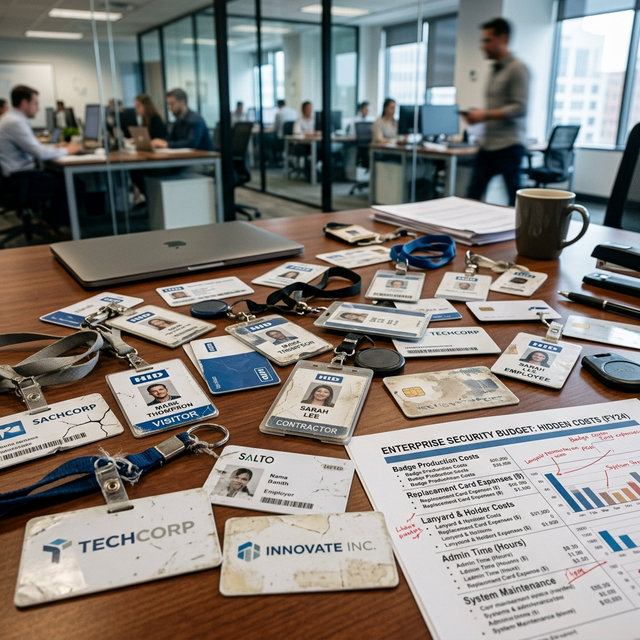
Your CFO sees the badge line item in the security budget: card stock, printers, and maybe a badge office lease. That’s the visible cost. The invisible costs are bigger — and they’re buried in HR onboarding, IT help desk, facilities operations, and risk management budgets where nobody connects them to the badge.
The visible costs
A standard RFID proximity badge costs $3–$8 per card. A smart card (DESFire, SEOS) costs $5–$15. A badge printer costs $3,000–$8,000. Supplies (ribbons, overlays, cleaning kits) cost $2,000–$5,000 per year. For a 5,000-employee enterprise with 15% annual turnover, that’s 750 new badges per year in card stock alone — plus replacements for lost, damaged, and demagnetized cards.
Visible badge cost for a 5,000-employee site: $15,000–$30,000/year.
The hidden costs
Badge office staffing. Someone has to operate the badge printer, take photos, encode cards, and hand them to new employees. At large enterprises, this is a part-time or full-time position. At smaller organizations, it’s a facilities coordinator who spends 5–10 hours per week on badge operations instead of their primary job. Cost: $10,000–$40,000/year in loaded labor.
New hire provisioning delays. A new employee can’t enter the building until they have a badge. If the badge office is closed (weekend, evening, holiday) or backed up (batch onboarding), the employee waits — or gets escorted by someone with badge access. Every hour of wait time costs productivity. For batch onboarding events (20+ new hires), the badge office becomes a bottleneck that delays the entire orientation schedule.
Lost and stolen badges. Industry estimates: 15–25% of employees lose their badge at least once per year. Each lost badge triggers: a help desk ticket, a badge deactivation in the PACS, a new badge encoding, and a pickup at the badge office. At $20–$30 in loaded cost per replacement (including labor), 5,000 employees losing badges at a 20% rate is $20,000–$30,000/year.
The security cost. This is the hidden cost that doesn’t appear in any budget — until something goes wrong. Proximity badges can be cloned with $25 of equipment from the internet. Smart cards are harder to clone but not impossible. A lost badge that isn’t reported for 24 hours (common) is a valid credential in someone else’s hands for 24 hours. The security risk of cloneable, losable, lendable physical credentials is real — it’s just amortized across the risk register rather than the badge budget.
Total hidden cost for a 5,000-employee site: $40,000–$100,000/year.
The combined visible and hidden cost: $55,000–$130,000/year. Every year. For one site.
The contractor multiplier
The numbers above cover employees — people on the payroll with permanent badges. But many enterprise buildings also credential contractors, vendors, and long-term visitors. A large corporate campus might issue 2,000–5,000 contractor badges per year, each with a shorter lifecycle (project duration, typically 3–12 months) and a higher replacement rate (contractors are less invested in keeping track of a badge that isn’t “theirs”).
Contractor badges have the same visible and hidden costs as employee badges — plus an additional administrative burden: verifying contractor identity, coordinating with the contractor’s employer, managing badge return at project end (most contractors don’t return badges), and deactivating access when the project scope changes.
For enterprises with significant contractor populations — construction, professional services, technology campuses — the contractor badge cost can equal or exceed the employee badge cost.
The multi-site calculation
Everything above is per-site. An enterprise with 10 buildings doesn’t have one badge office — it has 10 badge processes, 10 sets of printers, 10 replacement cycles, and 10 times the lost-badge volume.
For a 10-site enterprise with 50,000 employees across all sites, the combined badge cost (visible + hidden) approaches $550,000–$1.3 million per year. That’s a line item large enough to fund an entirely different security architecture.
The alternative economics
Identity-based access eliminates the badge entirely. Employees use their government-issued digital ID (mDL) to enter the building — verified at the reader, authorized at the panel. No badge to produce, encode, lose, replace, clone, or deactivate.
The economic model shifts from per-employee variable costs (every hire needs a badge, every lost badge needs a replacement) to per-station platform costs (the software subscription doesn’t grow with headcount). For multi-site enterprises, the savings compound across every building — and the compound savings are what get the CFO’s attention.
The badge cost is only half the story — if you’re also paying per-user mobile credential fees, that’s a separate line item worth scrutinizing.