Government Identity Without Biometrics: A Wallet-First Alternative for Modern Public Infrastructure
Government identity systems have traditionally depended on biometrics as the primary mechanism for verifying individuals. Fingerprints, facial recognition, iris scans, and other physiological markers have been treated as the most reliable way to establish who someone is.
This approach solved an important problem at the time. It reduced reliance on physical documents and enabled large scale identity programs. However, it also introduced new challenges around privacy, infrastructure complexity, accessibility, and long term scalability.
A new model is emerging that does not replace government identity but changes how verification is performed in everyday interactions. Instead of relying on biometric capture at every point of access, identity can be verified through cryptographically secured mobile wallet credentials.
At KeyShare, we view this as a shift from biometric dependence to wallet-based identity assurance.
The limitations of biometric-centric identity systems
Biometric systems were designed to increase certainty, but they also introduce operational and structural constraints that are becoming more visible at scale.
Infrastructure dependency. Biometric systems require specialized hardware such as scanners, cameras, or sensors. Every verification point becomes dependent on physical infrastructure that must be installed, maintained, and standardized.
Environmental sensitivity. Performance can vary depending on lighting conditions, sensor quality, user positioning, or physical wear over time. This creates inconsistency in real world deployments.
Privacy concerns. Biometric data is inherently sensitive because it cannot be changed once compromised. Unlike passwords or tokens, fingerprints or facial features are permanent identifiers.
Accessibility challenges. Not all individuals can reliably use biometric systems due to physical conditions, aging, or device limitations.
Centralization risk. Large biometric databases create high value targets and increase systemic risk if compromised.
These limitations do not mean biometrics are obsolete. They simply indicate that biometrics are not ideal as the only or primary method of identity verification in modern digital infrastructure.
The shift toward wallet-based government identity
Mobile wallets introduce a different paradigm. Instead of collecting biometric data at every verification point, identity is issued once by a trusted authority and stored as a cryptographically signed credential inside a secure wallet environment.
This changes the verification model fundamentally.
Rather than asking a system to match a physical trait, the system verifies a digitally signed assertion that originates from a trusted issuer.
These credentials can represent:
- National identity attributes
- Driving privileges
- Age verification
- Residency status
- Eligibility for public services
The key distinction is that identity becomes portable, verifiable, and user controlled.
Verification without repetition
In biometric systems, verification often requires repeated capture of the same physical trait. Every interaction becomes a new scan or match event.
In wallet-based systems, identity is verified through a single cryptographic exchange.
A typical flow looks like this:
- A citizen initiates an interaction using their mobile device
- The wallet presents a government-issued digital credential
- The verification system validates the cryptographic signature
- Access or approval is granted based on verified attributes
No biometric capture is required at the point of interaction. Identity is already proven by the issuing authority and simply validated in real time.
NFC as a public sector interaction layer
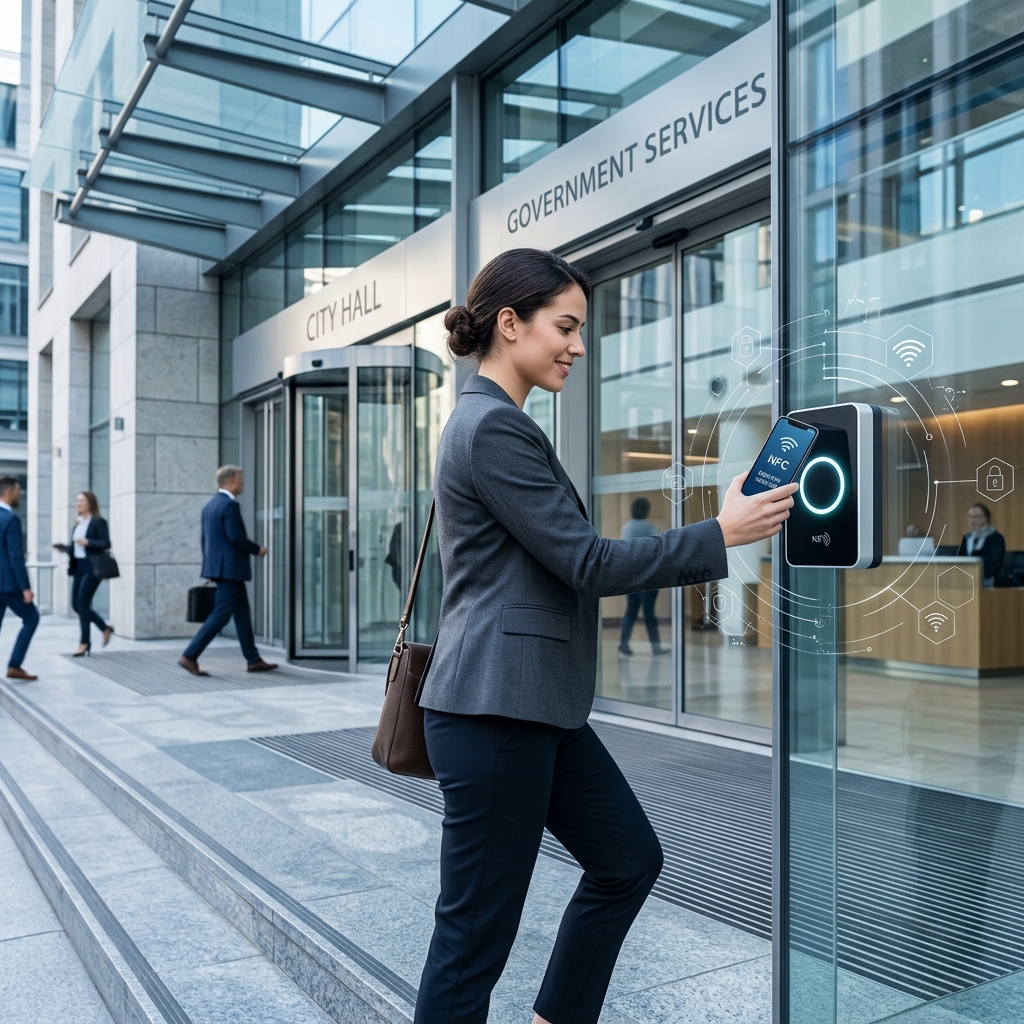
For government environments, usability and speed are critical. NFC provides a controlled and intuitive way to initiate identity verification in physical spaces.
Instead of scanning a document or capturing a biometric sample, the user simply taps their device to a reader.
This interaction model is especially effective in:
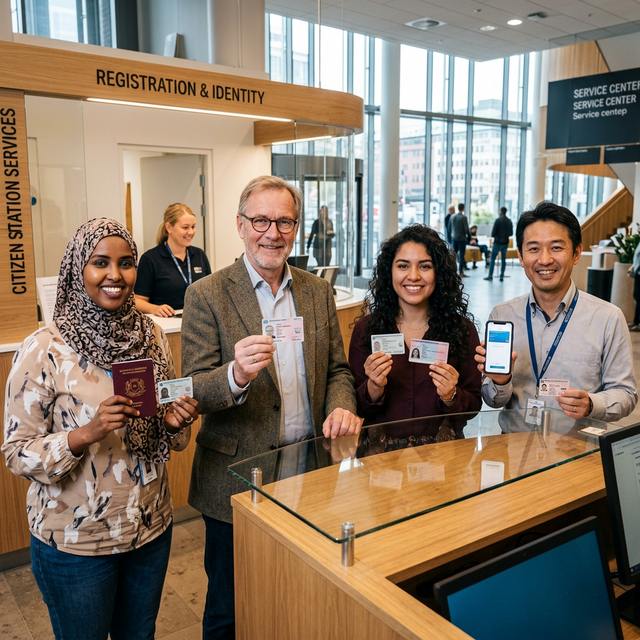
- Citizen service centers
- Transportation systems
- Border and immigration checkpoints
- Public benefit distribution points
- Secure building access for government employees
The interaction is consistent, predictable, and does not require specialized user behavior.
Reducing dependency on biometric databases
One of the most important shifts enabled by wallet-based identity is the reduction of reliance on centralized biometric databases.
In a wallet-based model:
- Identity is verified through cryptographic proof
- Sensitive biometric storage is not required for every transaction
- Verification can occur offline or at the edge
- Systems rely on signed credentials rather than raw biological data
This reduces systemic risk while improving interoperability between different government systems.
Security through cryptographic assurance
Biometric systems rely on probabilistic matching. No biometric match is perfect, and systems must account for thresholds, false positives, and false negatives.
Wallet-based identity verification replaces this with deterministic cryptographic validation.
If a credential is valid and signed by a trusted issuer, it can be verified instantly without ambiguity.
This creates a more consistent security model that is easier to audit and scale across jurisdictions.
Interoperability across government systems
Modern government infrastructure is rarely centralized. Different departments, regions, and agencies often operate independent identity systems.
Wallet-based identity allows these systems to interoperate through shared standards rather than shared databases.
A single credential can be:
- Issued by one authority
- Recognized by multiple agencies
- Verified across different infrastructure layers
This reduces duplication and simplifies cross-agency identity verification workflows.
The role of hardware anchors in public trust systems
While wallet credentials provide portability, government systems still require strong trust anchors at the verification point.
Hardware-based verification devices introduce a secure layer that validates credentials at the edge of the system. This ensures:
- Consistent cryptographic validation
- Protection against tampering or spoofing
- Reliable operation in offline or low connectivity environments
- Auditability for regulated deployments
At KeyShare, we design verification systems that operate with hardware-rooted trust while remaining compatible with existing government infrastructure.
Why this model scales better than biometrics alone
Biometric systems scale by increasing infrastructure density. More sensors, more databases, more integration points.
Wallet-based systems scale differently. They scale through interoperability and software-defined trust.
This creates several advantages:
- Lower deployment cost per verification point
- Reduced maintenance overhead
- Faster rollout across regions
- Easier compliance with evolving privacy regulations
- Improved user experience without procedural complexity
Instead of expanding physical capture infrastructure, governments can expand credential acceptance infrastructure.
KeyShare’s approach to biometric alternatives
At KeyShare, we focus on enabling identity systems that reduce reliance on repeated biometric capture while maintaining high-assurance verification.
Our approach emphasizes:
- Wallet-native identity presentation
- Instant NFC-based verification flows
- Cryptographic validation of government-issued credentials
- Integration with existing public sector infrastructure
- Edge-based trust enforcement for high-security environments
We do not position this model as a replacement for national identity systems. We position it as a more efficient and privacy-conscious verification layer for everyday interactions.
Biometric identity systems played a critical role in modernizing government infrastructure. However, as digital ecosystems expand, their limitations in scalability, privacy, and operational efficiency become more pronounced.
Wallet-based identity verification introduces a different model. It reduces dependence on repeated biometric capture and replaces it with cryptographically verifiable credentials that can be presented instantly through mobile devices.
This shift does not remove trust from government systems. It redistributes trust from physical capture events to secure digital issuance and verification.
At KeyShare, we see this as the next phase of public identity infrastructure — where verification becomes faster, more interoperable, and less dependent on invasive or repetitive biometric processes.