Hotel Check-In in 60 Seconds: What It Actually Takes
The average hotel check-in takes 3 to 5 minutes. For a walk-in without a reservation, it’s 5 to 10 minutes. These aren’t technology limitations — they’re workflow limitations. Every minute a guest spends at the front desk is a minute they’re not in their room, not at the restaurant, not having the experience they came for.
Getting check-in under 60 seconds isn’t about making each step faster. It’s about eliminating steps entirely.
Anatomy of a 4-minute check-in
A typical check-in involves six sequential tasks: reservation lookup (staff searches by name or confirmation number), identity verification (staff inspects a physical ID card), payment authorization (staff swipes or inserts a card), key encoding (staff programs a plastic keycard), loyalty offer (staff asks about enrollment), and information delivery (staff explains WiFi, breakfast, elevator directions).
Each task takes 30–60 seconds. They happen sequentially because each depends on the output of the previous one. The bottleneck isn’t any single task — it’s the serial nature of the workflow.
The parallel architecture
A 60-second check-in requires two architectural changes.
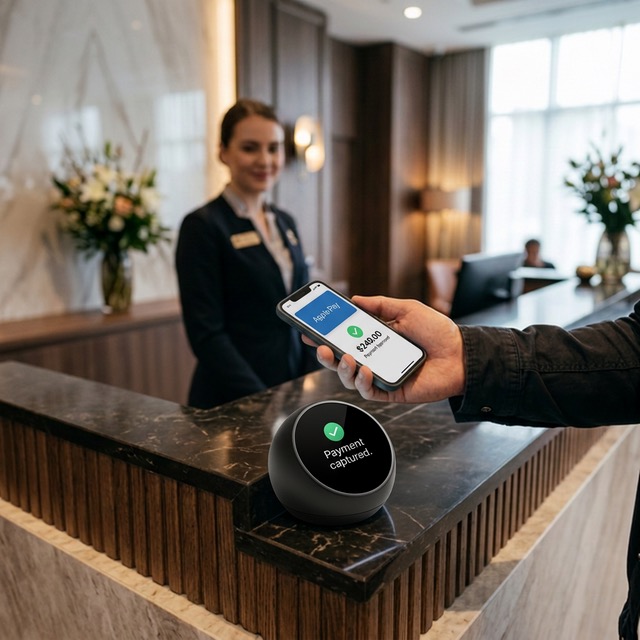
First, collapse multiple tasks into a single interaction. When a guest taps their phone on an NFC reader, the tap can simultaneously trigger identity verification (reading the digital ID), payment credential capture (if the wallet contains a payment card), and loyalty membership detection (if the wallet contains a loyalty pass). Three tasks, one tap, under 3 seconds.
Second, automate the tasks that don’t require guest input. Reservation matching can happen automatically when the verified name matches a reservation. Key provisioning can happen automatically once the reservation is confirmed. Compliance logging happens in the background. The guest doesn’t need to participate in these tasks — they just need to receive the result.
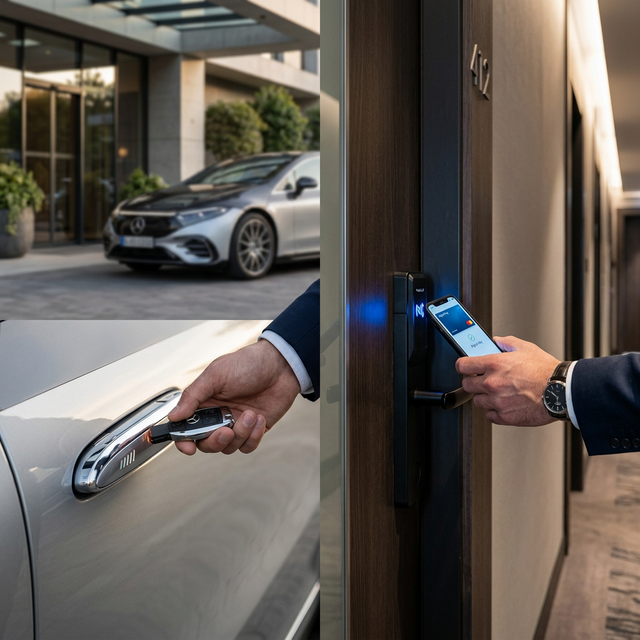
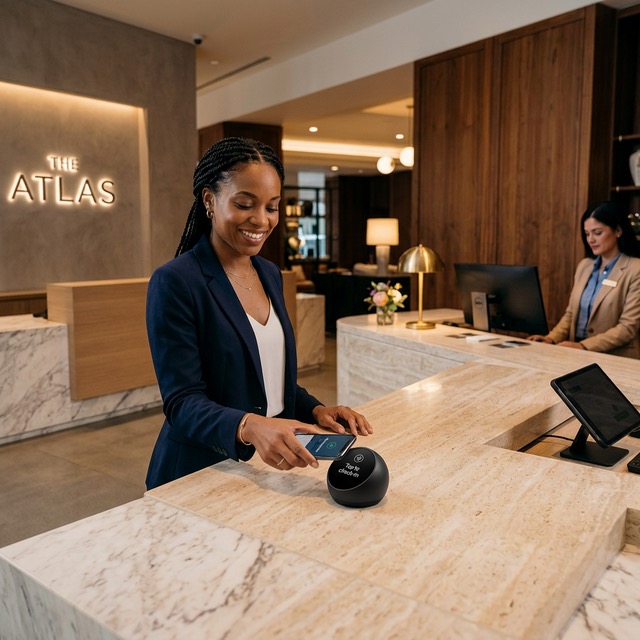
The KeyShare Puck is the hardware that enables this collapse. It’s an NFC reader that captures digital credentials — identity, payment, loyalty — in a single tap interaction. The Guest Experience Platform is the software that orchestrates the parallel workflow: receive verified identity from Puck → match to reservation → authorize payment → provision wallet key → check loyalty status → offer enrollment — all within seconds.
What the guest experiences
From the guest’s perspective, the interaction is simple:
- Approach the front desk (or kiosk, or reception tablet).
- Staff says “Welcome, may I see your ID?” (or the kiosk prompts “Tap your phone to check in”).
- Guest taps phone on the Puck.
- Staff says “You’re all set — Room 1412, elevators to your right. Your key is in your wallet.”
The guest’s active participation was a single tap. Everything else happened in the background in under 30 seconds.
What happens in those 30 seconds
Behind the tap, the orchestration engine executes a workflow:
The Puck establishes an NFC session with the guest’s phone (ISO 18013-5 protocol). The digital ID is read and its cryptographic signature is verified against the issuing authority. The verified name and date of birth are matched against the reservation database. If a match is found, the reservation is confirmed. A wallet room key is provisioned and delivered to the guest’s native mobile wallet through the same NFC session. Payment authorization is captured if a payment credential was presented. The verification event, consent, and key delivery are logged for compliance. If the guest is eligible for loyalty enrollment, the enrollment offer is queued for the staff to present conversationally.
This entire sequence is designed to complete in under 30 seconds — including the NFC session, cryptographic verification, reservation match, and key provisioning. The longest step is the NFC session establishment (under 500 milliseconds for the cryptographic key exchange). Everything after that is software orchestration.
Walk-ins in 90 seconds
Walk-in check-in is harder because there’s no reservation to match. The guest’s identity still needs to be verified, a reservation needs to be created, room availability needs to be checked, and payment needs to be collected.
With the same tap-first architecture, walk-in check-in drops from 5–10 minutes to under 90 seconds. The identity verification happens instantly (digital ID tap). The GEP auto-populates the reservation form with verified guest data — name, contact information — eliminating manual data entry. Room assignment and payment capture follow, and the wallet key is provisioned at the end of the flow.
The staff member’s role shifts from data entry to hospitality: confirming room preferences, offering upgrades, welcoming the guest by name — using the information the tap just provided.
The offline question
Hotel IT directors ask a critical question: “What happens when the internet goes down?”
The answer matters because hotel WiFi and internet connections are not as reliable as the industry pretends. The check-in system must work during outages — not gracefully degrade into a paper-based fallback.
The GEP architecture is offline-first. A local instance runs on-premise at each property with a mirrored database. Core operations — identity verification, reservation lookup, key provisioning — execute locally. They don’t require cloud connectivity. The Puck communicates with GEP Local over USB, not over the network. When connectivity returns, the local instance syncs with the cloud.
This means a 60-second check-in stays a 60-second check-in during an internet outage. No degradation. No “sorry, our system is down.”
The entire flow is offline-first — no internet required for core check-in.