The Hotel GM’s Guide to Digital ID: mDL, EUDI, and What You Need to Know
Your guests are starting to carry government-issued digital identification on their phones. Mobile driver’s licenses (mDLs) are live in a growing number of US states (12+ as of this writing) with more in pilot programs. The European Union has mandated digital identity wallets for all member states. Gartner projects 500 million smartphone users will have a digital identity wallet by 2026.
Hotels have no standardized way to accept these credentials today. That’s about to become a problem — and an opportunity.
What is a digital ID?
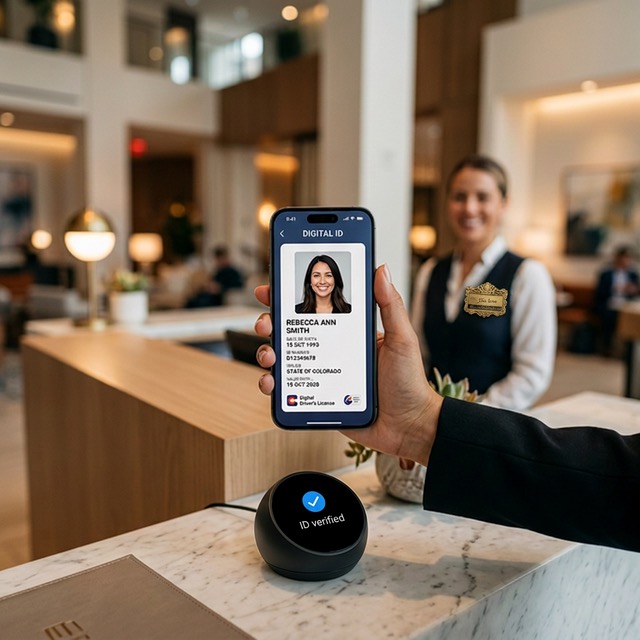
A mobile driver’s license is a cryptographically signed credential stored in a person’s phone wallet. It contains the same information as a physical driver’s license — name, date of birth, photo, address, license number — but with two critical differences.
First, it’s cryptographically verifiable. A physical ID can be forged. A digital ID carries a cryptographic signature from the issuing authority (the state DMV, the national government) that can be verified mathematically. If the signature checks out, the credential is genuine — no human judgment required.
Second, it supports selective disclosure. A physical ID shows everything — your address, your date of birth, your license number — whether the verifier needs all of that or not. A digital ID lets the holder choose which attributes to share. A hotel verifying identity at check-in might need name, date of birth, and photo — but not address or license number. The guest shares only what’s necessary.
The two standards that matter
Two standards govern digital ID for the foreseeable future.
ISO 18013-5 is the international standard for mobile driver’s licenses. It defines how the credential is stored on the phone, how it’s presented to a verifier (via NFC or QR code), and how the verifier checks the cryptographic signature. This is the standard used by US state mDLs and increasingly adopted globally.
EUDI (European Digital Identity) is the EU’s framework for digital identity wallets. Every EU member state must provide citizens with a digital wallet by 2026 under the eIDAS 2.0 regulation. The EUDI Architecture Reference Framework builds on existing standards — including ISO 18013-5 for identity credentials and W3C Verifiable Credentials for other credential types.
For hotels, the practical implication is: if your check-in system can verify ISO 18013-5 credentials, you can accept mDLs from US states today and EUDI credentials from EU member states as they roll out.
Why hotels should care now
Three reasons this matters for hotel operations today, not in some abstract future.
Compliance is coming. As digital ID adoption grows, regulators will increasingly expect that businesses accepting physical ID also accept digital equivalents. Several US states have already passed laws requiring government agencies to accept mDLs. Private sector requirements are likely to follow — especially in regulated identity verification contexts like hotel check-in.
Guest expectations are shifting. A guest who uses their mDL at the airport, the rental car counter, and the bar expects to use it at the hotel. If your front desk asks for a physical card after the guest just went through TSA with their phone, the friction is noticeable.
Operational efficiency. Manual ID verification — staff visually inspecting a physical card — is slow, subjective, and unreliable. A cryptographically verified digital ID eliminates the judgment call. The verification is mathematical, not visual. This matters for compliance documentation: an audit trail that says “cryptographic signature verified against California DMV issuing authority” is stronger than “front desk agent looked at a card.”
What your property needs
Accepting digital ID at check-in requires three things.
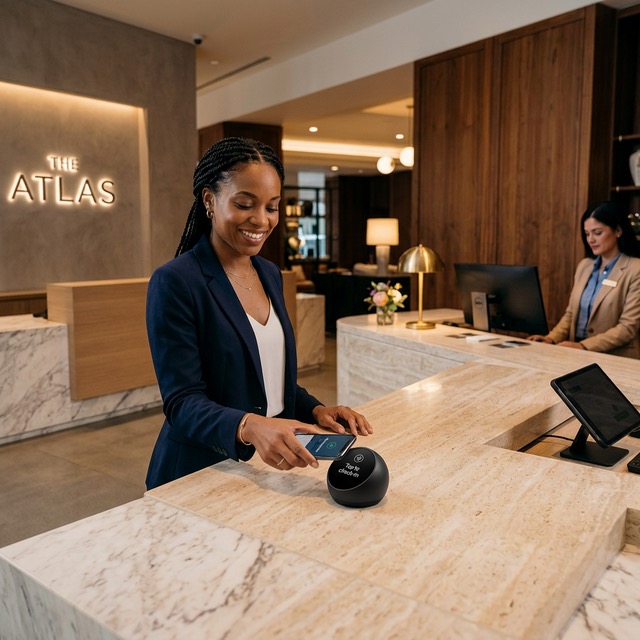
Hardware that can read NFC credentials. Digital IDs are presented via NFC — the guest holds their phone near a reader, and the credential is transmitted. The KeyShare Puck is purpose-built for this: it reads ISO 18013-5 credentials via NFC, verifies the cryptographic signature, and returns the verified identity attributes to the check-in system.
Software that orchestrates the verification. The Puck handles the NFC protocol and cryptographic verification. The Guest Experience Platform (GEP) orchestrates the check-in workflow — matching the verified identity to the reservation, triggering key delivery, logging the verification for compliance, and managing consent.
PMS integration. The verified identity data needs to flow into your property management system. The GEP includes pre-built adapters for Opera, Mews, Apaleo, BookingCenter, Shiji, and Cloudbeds — so the identity verification result populates your existing guest record without manual data entry.
The timeline for your property
You don’t need to wait for 100% mDL adoption to benefit. Even with 12 states live today, a meaningful percentage of your guests — especially business travelers and frequent flyers — already carry digital ID. The percentage increases every quarter as more states launch.
The infrastructure investment is modest: a Puck at the front desk, the GEP software, and a PMS adapter configuration. And because the GEP is offline-first, it works even when your internet doesn’t. The same infrastructure that accepts digital ID today also delivers wallet keys, processes contactless payments, and enrolls loyalty members — it’s not a single-purpose system.
Explore how digital ID acceptance fits into the complete check-in experience →