The True Cost of Plastic Keycards (And the Math Behind Eliminating Them)
Every hotel GM knows keycards cost money. Most underestimate how much.
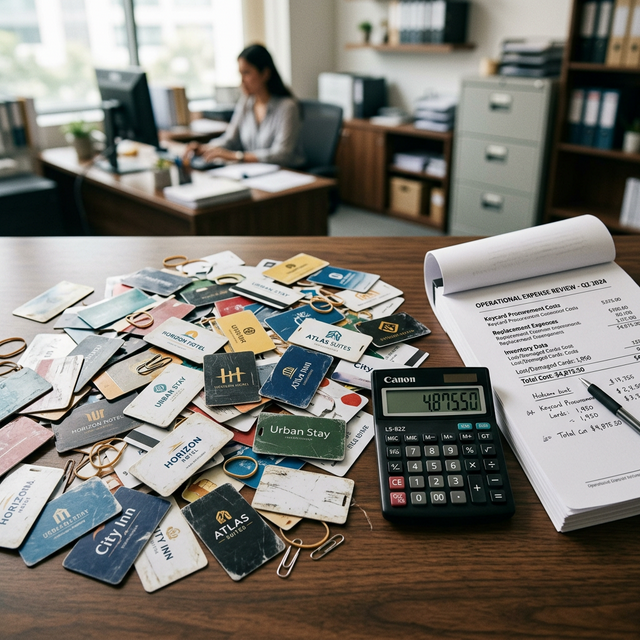
The direct cost of a blank keycard is $0.50 to $2.00 depending on the technology (magstripe vs. RFID), the vendor, and the order quantity. For a 150-room hotel at 70% occupancy, that’s roughly 38,000 check-ins per year. At $0.75 per card, that’s $28,500 per year in card stock alone.
But card stock is only the beginning.
The costs you don’t see on the PO
Re-encoding. Keycards get demagnetized by phones, other cards, and random electronic interference. Industry data suggests 8–15% of keycards need re-encoding during a guest’s stay. Each re-encode requires a trip to the front desk, a staff interaction, and a new card (or a re-encoding of the existing one). At a 150-room property, that’s 3,000–5,700 re-encoding events per year.
Replacement cards. Guests lose keycards. They leave them in the room, in their car, in their jacket pocket at the restaurant. Replacement rates run 5–10% of total check-ins. Each replacement consumes a new card, a staff interaction, and — critically — 3–5 minutes of the guest’s time that should have been spent enjoying the property.
Key encoding equipment. Front desk encoders cost $500–$2,000 per unit. Properties with multiple front desk stations, a concierge desk, and a night audit station need multiple encoders. Maintenance and replacement cycles add ongoing cost.
Disposal. Plastic keycards are not easily recyclable. Most end up in landfill. For hotels with sustainability commitments — and guests increasingly expect them — the environmental cost has a brand dimension even if it doesn’t appear on the P&L.
Staff time. This is the hidden multiplier. Every re-encode and replacement consumes 3–5 minutes of staff time. At 6,000 re-encode/replacement events per year and 4 minutes each, that’s 400 hours of staff time — roughly a quarter of a full-time front desk position, spent on keycard logistics instead of guest service.
The total cost
For a 150-room property at 70% occupancy:
| Cost Component | Annual Estimate |
|---|---|
| Card stock (38,000 × $0.75) | $28,500 |
| Re-encoding labor (4,500 events × $12/hr × 4 min) | $3,600 |
| Replacement cards (3,000 × $0.75) | $2,250 |
| Encoder maintenance (3 units) | $1,500 |
| Guest friction / satisfaction impact | Unquantified — but real |
| Sustainability cost | Unquantified — brand dependent |
| Conservative total | ~$36,000/year |
This is conservative. Properties with higher occupancy, higher replacement rates, or premium card stock spend significantly more. Resort properties with multiple room keys per guest (couples, families) multiply the card stock cost.
The wallet key alternative
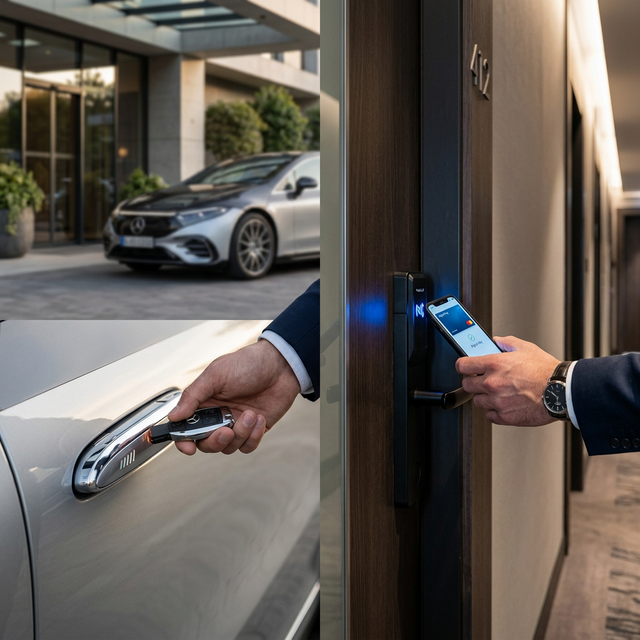
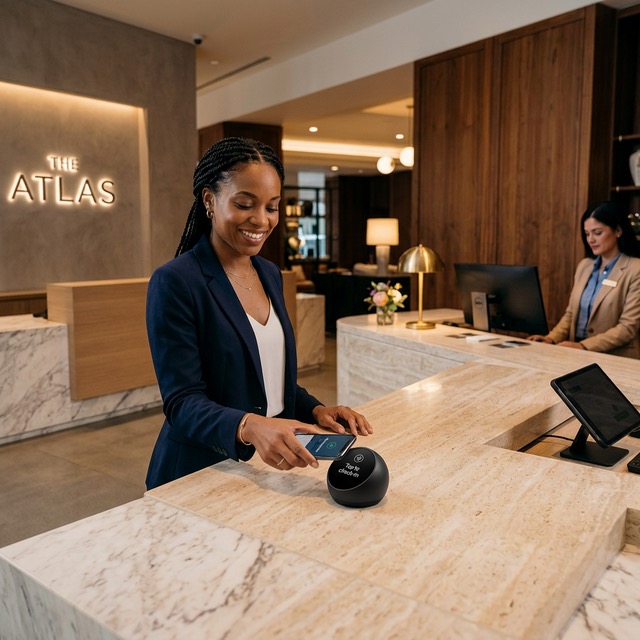
A wallet key — a digital room key provisioned directly to the guest’s native mobile wallet — has a near-zero marginal cost per key. There’s no physical card to produce, encode, lose, re-encode, or dispose of. The key is provisioned during the check-in interaction (via the KeyShare Puck) and delivered to the guest’s phone in seconds.
The cost structure shifts from per-unit variable (every check-in consumes a card) to platform fixed (the Guest Experience Platform (GEP) software and Puck hardware have a fixed cost regardless of how many keys are provisioned). For most properties, the breakeven is reached within the first year.
What doesn’t go away
Wallet keys don’t eliminate physical keycards overnight. Some guests won’t have compatible phones. Some will prefer a physical card. Properties need to maintain keycard capability for the transition period.
The practical approach is to make wallet keys the default and keycards the fallback. If 70% of guests receive wallet keys — achievable when the delivery model removes the app download barrier —, card stock consumption drops 70%. Re-encoding events drop proportionally. The $36,000 line item doesn’t disappear, but it shrinks to under $11,000 — and the staff time savings are immediate.
The finance conversation
When presenting this to ownership or asset management, the keycard cost elimination is the easiest line item to quantify. It’s concrete, defensible, and doesn’t require assumptions about behavioral change. The card stock cost is on the PO. The re-encoding rate is in the front desk logs. The math is straightforward.
But frame it as one component of a larger operational efficiency story — not the headline. The real value of the check-in platform is the 60-second check-in, the potential for 70%+ key adoption (based on early deployments), the compliance automation, and the loyalty enrollment. Keycard savings are the financial proof point, not the strategic narrative.