Hotel Keyless Entry Systems Built on Identity-First Access: A New Standard for Hospitality Credentialing
In hospitality, the moment a guest arrives defines everything that follows. Traditional hotel keyless entry systems improved convenience compared to physical keys, yet they still inherit a structural weakness. Most of them are still built around apps, manual onboarding, and fragmented identity verification steps that introduce friction before a guest ever reaches their room.
At KeyShare, we approach this differently. We do not treat the mobile phone as a replacement for a key card. We treat identity itself as the credential. Everything else becomes a downstream authorization decision.
This shift is not incremental. It changes how hotel keyless entry systems are designed, deployed, and scaled.
Why traditional hotel keyless entry systems still fail at scale
On the surface, mobile keys and app-based access systems appear modern. Guests download an app, verify themselves, and receive a digital room key. In practice, adoption remains inconsistent across properties for a few structural reasons.
First, app friction is still a major barrier. Guests do not want to download yet another application for a single stay. Even when they do, onboarding is often slow, dependent on connectivity, and prone to drop-off.
Second, identity verification is often disconnected from the access layer. The system knows a room should be assigned, but it does not securely bind that assignment to a verified, cryptographically trusted identity in real time.
Third, integration complexity prevents hotels from upgrading legacy infrastructure. Many properties rely on PMS systems, access controllers, and reader networks that were never designed for modern digital identity flows.
The result is a paradox. Hotels invest in “keyless” systems but still rely on queues, manual verification, or hybrid workflows at the front desk.
The KeyShare approach to hotel keyless entry systems
KeyShare is built around a different principle. Identity is the credential. Once identity is verified, access is simply a policy decision.
Instead of relying on app downloads or isolated key generation systems, KeyShare uses an NFC-based identity interaction that works directly with a guest’s existing mobile wallet and digital identity.
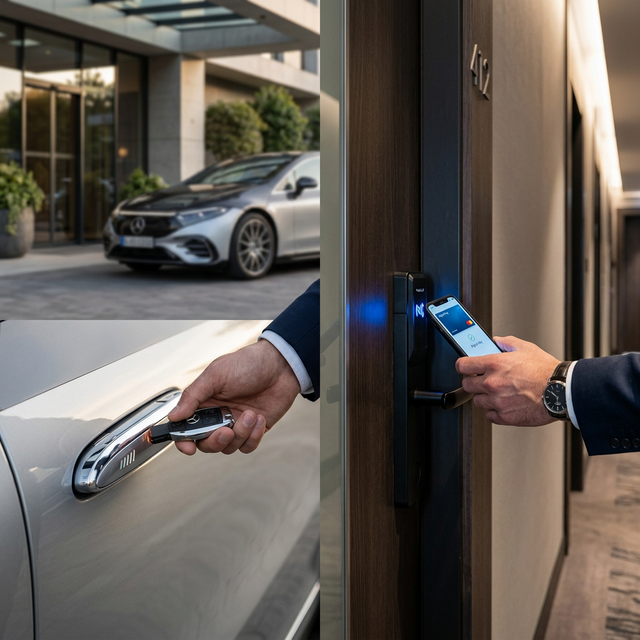
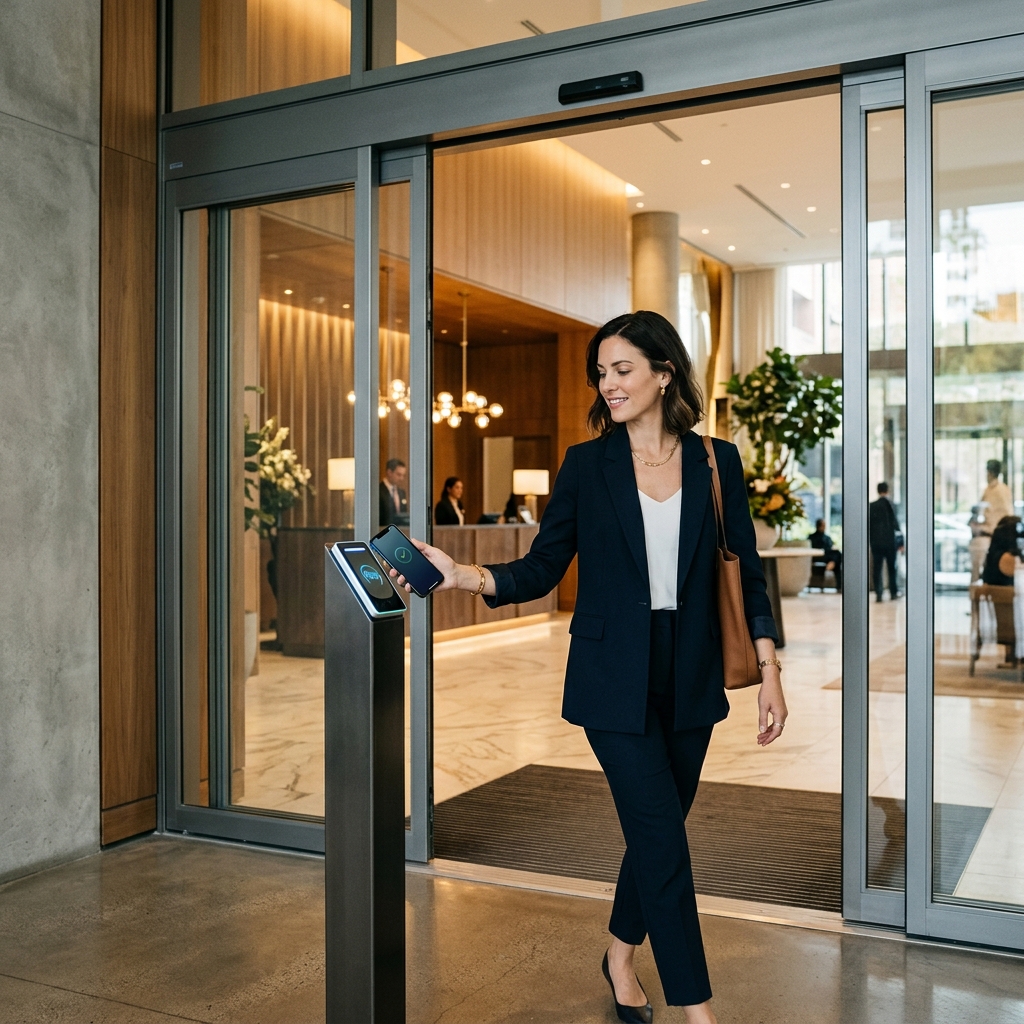
A guest does not install anything. They simply tap their phone.
That single interaction triggers three tightly controlled steps.
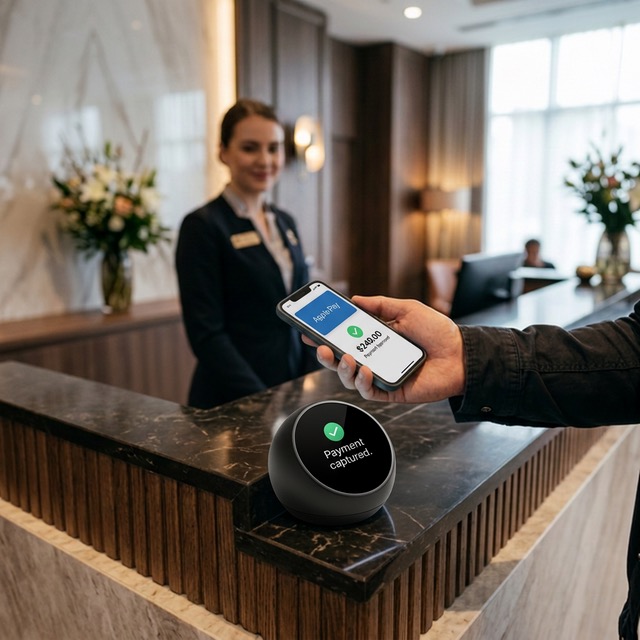
First, the tap initiates a secure NFC exchange between the guest device and the KeyShare Puck, our hardware identity verification device.
Second, the system performs cryptographic verification of the guest’s digital identity or government-issued credential directly on device, often in under one second.
Third, the system authorizes and delivers the correct credential back to the guest device. That credential can be a room key, building access pass, or any contextual authorization required by the property.
This model removes onboarding entirely. It replaces it with identity recognition.
The role of hardware trust in modern hotel access
Most hotel keyless entry systems rely heavily on software trust. KeyShare introduces something different — a hardware root of trust.
The KeyShare Puck is not just an NFC reader. It is a cryptographically secure identity verification device built with validated security modules and hardware security architecture. This enables secure credential validation even in offline or constrained environments.
This matters in hospitality environments where uptime, speed, and resilience are non-negotiable. A hotel cannot afford access failure due to network latency or app synchronization issues.
With KeyShare, identity verification is deterministic and verifiable at the edge.
Eliminating the app layer from hotel guest experience
One of the most important shifts in modern hotel keyless entry systems is the removal of app dependency.
Apps introduce friction in three ways. They require installation, they require account creation, and they require behavioral compliance from guests who may only interact with the system once.
KeyShare eliminates all of this.
Instead of an app, guests use their existing mobile wallet or digital identity stored on their device. This may include government-issued digital IDs or standards-based mobile driver’s licenses depending on jurisdiction.
The hotel does not manage apps. It manages access policies.
This creates a universal interaction model. Whether a guest is checking in, accessing a room, or entering a restricted facility within the property, the experience remains identical. Tap, verify, authorize.
How identity-driven hotel keyless entry actually works
The operational flow is designed to be simple at the surface but highly structured underneath.
A guest arrives at the property and approaches a check-in point or access terminal equipped with KeyShare.
They tap their phone on the KeyShare Puck using NFC. No scanning or app launch is required.
The Puck initiates a secure, standards-based exchange and reads the guest’s digital credential. This credential is verified cryptographically using a hardware-secured module.
Within a fraction of a second, the system confirms identity validity and contextual permissions.
Once verified, the system issues a credential directly to the guest device. This credential is dynamic and context-aware. It might grant access to a room, a floor, a gym, or a conference area depending on hotel configuration.
The guest proceeds immediately without waiting for staff intervention.
The entire process is designed to reduce check-in time by up to 80 percent compared to traditional front desk workflows.
Integration without infrastructure replacement
One of the biggest barriers in upgrading hotel keyless entry systems is infrastructure replacement cost.
Hotels already operate with PMS systems, Mercury-style control panels, and OSDP-based reader networks. Replacing them is not economically viable for most properties.
KeyShare is designed to integrate rather than replace.
Our platform connects with existing property management systems and access control infrastructure. This allows hotels to layer identity-driven access on top of their existing hardware ecosystem.
There is no requirement for rip-and-replace deployment. Instead, KeyShare functions as an identity and credential orchestration layer that sits above existing systems.
Beyond keys: identity as a hospitality infrastructure layer
Hotel keyless entry systems are only one part of a larger transformation in how hospitality manages identity.
Once identity becomes the core credential, hotels can extend the same framework into loyalty enrollment, payment authorization, and guest personalization systems.
A single verified identity can trigger multiple outcomes without requiring repeated verification.
For example, a guest can check in, receive a room key, enroll in a loyalty program, and access premium facilities — all from a single NFC interaction.
This is not just operational efficiency. It is a structural redesign of guest interaction architecture.
Security and compliance in modern hotel access systems
Security in hotel keyless entry systems is no longer just about preventing unauthorized room entry. It is about ensuring that identity verification itself is tamper-resistant and standards-aligned.
KeyShare supports internationally recognized identity standards including mobile driver’s licenses and ICAO-based digital travel credentials where applicable. This ensures interoperability across regions and regulatory frameworks.
All verification processes are cryptographically secured and validated through hardware-based modules designed for high-assurance environments.
The business impact of identity-first hotel access
The operational impact of identity-driven hotel keyless entry systems is measurable across several dimensions.
Check-in times are significantly reduced, often by up to 80 percent compared to traditional workflows.
Front desk load is reduced, allowing staff to shift from transactional tasks to guest experience enhancement.
Credential management costs decrease because access is no longer tied to physical tokens or app-based licensing models.
Most importantly, guest adoption increases because there is no onboarding friction. Adoption targets above 70 percent become realistic where app-based systems typically plateau far lower.
The hospitality industry has spent years optimizing the wrong layer of the problem. It focused on digitizing keys instead of redefining identity.
KeyShare establishes a different foundation.
Hotel keyless entry systems should not depend on apps, passwords, or manual provisioning. They should depend on verified identity that is instantly recognized and securely authorized.
With a single NFC tap, guests move from arrival to access without interruption. No downloads. No accounts. No delays.
At KeyShare, we believe this is not a feature improvement. It is a new infrastructure standard for hospitality.
Identity is the credential. Everything else is friction.