Mobile Wallet Identity Verification: From Onboarding Systems to Instant Trust Exchange
Identity verification has historically been designed as a process, not an interaction. Users are onboarded into systems, asked to prove who they are through repeated steps, and then issued credentials that must be stored, remembered, or maintained. This approach made sense when identity systems were centralized and software dependent.
That model is now reaching its limits.
Mobile wallet identity verification represents a structural shift away from system-driven onboarding and toward user-controlled, cryptographically verifiable credentials that already exist on a person’s device. Instead of creating identity inside a platform, identity is simply presented from a trusted wallet environment and verified instantly.
At KeyShare, we design for this shift: identity verification should be a single interaction, not a multi-step workflow.
The core failure of traditional identity verification
Most identity systems still rely on friction-heavy architecture. Even when branded as “digital,” they often replicate legacy patterns:
- Account creation before access
- Manual document submission
- Centralized approval queues
- Session-based authentication tied to apps or portals
These systems treat identity as something that must be rebuilt per platform.
The result is predictable. Drop-off rates increase. Operational overhead rises. Human intervention becomes necessary in environments that are meant to be automated.
The fundamental issue is architectural: identity is not treated as portable.
Mobile wallets introduce portable identity
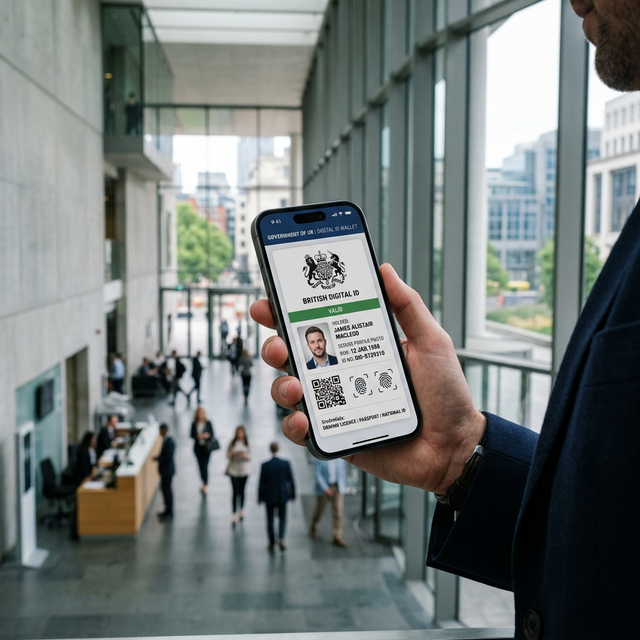
Mobile wallets change the structure of identity from a stored record to a cryptographically signed credential carried by the user.
Instead of asking a system to recreate identity, wallet-based verification allows an existing credential to be presented and validated on demand.
These credentials can include:
- Government-issued digital identity documents
- Mobile driver’s licenses aligned with modern standards
- Organizational access credentials
- Sector-specific verified attributes such as age or eligibility
The key shift is that verification is no longer about retrieving data from a database. It is about validating a signed assertion at the moment of interaction.
This reduces dependency on centralized authentication flows and enables real-time trust decisions.
NFC as the physical trigger for digital trust
While wallets solve the storage problem, they still require a consistent interaction layer in physical environments. This is where NFC becomes critical.
Near field communication provides a controlled, intentional mechanism for initiating identity exchange. It avoids ambiguity, reduces fraud vectors tied to visual scanning methods, and creates a predictable user experience.
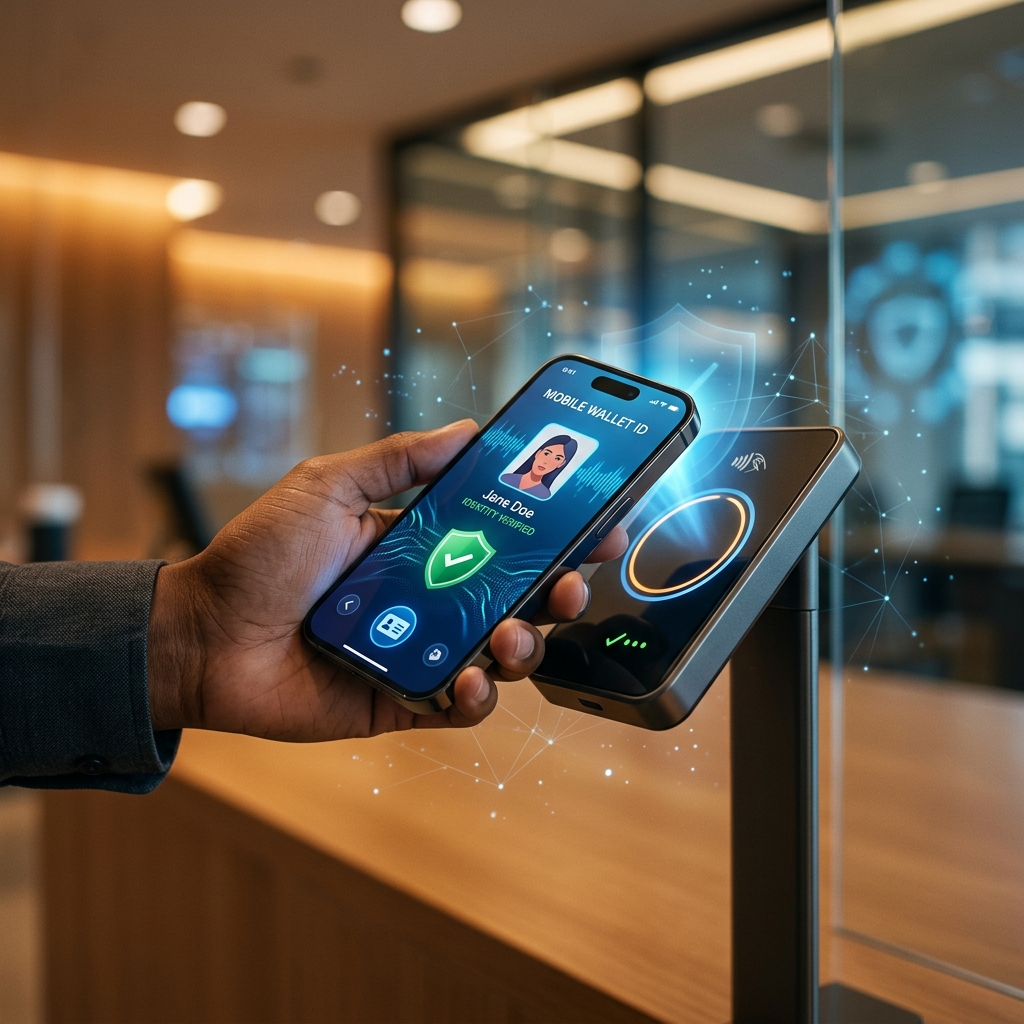
In a wallet-based NFC flow, the interaction typically looks like this:
- The user taps their phone against a reader
- A secure request is initiated between device and verifier
- The wallet responds with a cryptographically signed credential
- The verifier confirms authenticity and grants access
This process removes the need for typing, scanning, or pre-installed applications.
The interaction becomes physical, but the trust remains digital.
Identity verification as an exchange, not a login
A key limitation of legacy systems is that they treat identity verification as a login event. The user authenticates into a system, and then the system decides what to do next.
Wallet-based verification reverses this model.
Instead of logging in, the user presents a credential. The system does not authenticate a session. It validates an attribute or identity claim and responds accordingly.
This creates a more flexible model where identity can be used for:
- Access control
- Age or eligibility verification
- Room or service provisioning
- Government or regulated service interaction
The system no longer owns identity. It simply verifies it when needed.
Why apps are becoming a bottleneck
Mobile applications were originally introduced to simplify identity flows. In practice, they have become a new source of friction.
Common issues include:
- Forced downloads for one-time interactions
- Fragmented user experiences across providers
- High abandonment rates during onboarding
- Maintenance overhead for users and organizations
In high-volume environments such as hospitality, enterprise access, and public services, this model does not scale effectively.
Wallet-native identity removes this dependency entirely. The credential already exists on the device, eliminating the need for intermediate software layers.
Security shifts from system control to cryptographic proof
Traditional systems rely heavily on backend authentication. Identity is validated by comparing submitted information against stored records.
Wallet identity systems invert this model. Security is derived from cryptographic proof rather than system lookup.
This enables several advantages:
- Reduced reliance on centralized databases
- Lower exposure of sensitive identity data
- Faster verification cycles
- Stronger resistance to credential replication or replay attacks
In practice, verification happens at the edge, closer to the interaction point, rather than in a remote system.
The role of hardware in trust enforcement
Software-only identity systems are limited by the environment they run in. Mobile wallet verification becomes significantly stronger when paired with hardware-based trust anchors.
Hardware security modules or secure verification devices introduce a controlled execution environment where cryptographic validation can occur without external interference.
This is especially important in:
- Physical access control systems
- High-security facilities
- Government identity infrastructure
- Large-scale hospitality deployments
By anchoring trust in hardware, identity verification becomes more predictable and auditable.
Reducing identity to a single interaction
The long-term direction of wallet-based identity is simplification. The goal is not to add more digital steps, but to eliminate them.
The ideal flow becomes:
- User initiates interaction through a tap or proximity event
- Credential is presented from a wallet
- Verification occurs instantly
- Access or service is granted immediately
No accounts. No downloads. No manual verification loops.
This is not just a UX improvement. It is a structural redesign of how identity is used in physical and digital environments.
Operational impact in real systems
When identity verification is reduced to a single interaction, the effects extend beyond user experience.
Organizations typically see:
- Faster throughput in access points and check-in environments
- Reduced staffing requirements for verification tasks
- Lower onboarding costs for transient users
- Increased adoption due to zero-friction entry
More importantly, identity systems become easier to scale across multiple environments because the interaction model remains consistent.
Where KeyShare fits in this shift
At KeyShare, we focus on enabling identity verification as a native wallet interaction rather than a system-bound process.
Our approach centers on:
- Eliminating application dependency
- Enabling instant NFC-based credential exchange
- Supporting cryptographically verifiable identity standards
- Integrating with existing physical access infrastructure
- Operating across hospitality, enterprise, and regulated environments
We do not treat identity as a workflow. We treat it as an exchange between a device and a trusted verifier.
Mobile wallet identity verification represents a shift away from system-centric authentication toward user-centric credential presentation. It replaces onboarding with interaction, and replaces account creation with cryptographic proof.
As this model matures, identity systems will increasingly disappear from the user experience entirely. What remains is a simple interaction: a tap, a verification, and an outcome.
That is the direction we are building toward at KeyShare — where identity is not managed through friction-heavy systems but delivered as an instant, secure exchange.