Self-Service Visitor Check-In: Why Kiosks Are Finally Ready for Enterprise
Self-service visitor kiosks have been tried before in enterprise lobbies — and mostly abandoned. The 15-minute visitor badge problem persists because previous kiosk generations couldn’t verify identity. The reason: a kiosk that collects a visitor’s name and prints a badge is a data entry terminal, not a security device. It doesn’t verify identity. It doesn’t check watchlists. It doesn’t capture NDA signatures with legal validity. It automates the clerical parts of visitor management while skipping the security-critical parts.
That limitation made self-service kiosks acceptable for low-security environments (retail, co-working spaces) but insufficient for enterprise buildings where visitor identity verification is a compliance requirement.
Two technology changes make enterprise self-service viable now.
Change 1: Digital ID verification without a human
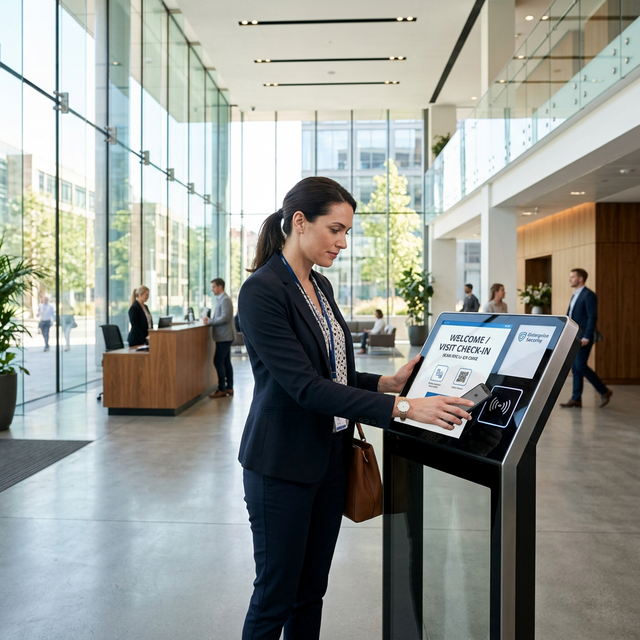
When the KeyShare Puck reads a visitor’s digital ID (mDL or EUDI credential), the verification is cryptographic — the credential’s digital signature is checked against the issuing authority’s key. No human judgment required. The kiosk verifies identity with higher accuracy than a receptionist visually inspecting a physical card, because the verification is mathematical rather than visual.
This eliminates the security gap that made previous kiosk deployments insufficient: the kiosk can now confirm that the visitor is who they claim to be, not just record what they typed.
Change 2: Credential delivery to the phone
Previous kiosk models printed a temporary badge — which the kiosk dispensed from a badge printer inside the enclosure. Badge printers in kiosks jam, run out of supplies, and produce badges that are trivially forged or shared.
The Puck delivers a digital access credential directly to the visitor’s native mobile wallet via the same NFC interaction that verified their identity. The credential is time-limited (expires at scheduled departure), scope-limited (authorized floors/areas only), and cryptographically tied to the visitor’s device. It can’t be shared, and it auto-revokes when the visit window closes.
No badge printer. No badge collection. No badge left in a desk drawer.
The Self-Service Kiosk Mode
The Visitor Experience Platform includes a Self-Service Kiosk Mode — a 15-state state machine that handles the complete visitor check-in workflow without staff involvement:
- Welcome. Screen displays “Tap your phone to check in” (or enter manually for visitors without digital ID).
- Identity verification. Visitor taps phone on Puck. Digital ID verified cryptographically.
- Face match (if configured). Live image compared against credential photo. Processed in RAM, discarded in under one second.
- Watchlist screening. Verified identity checked against the building’s denied party list.
- NDA presentation. If the visit requires an NDA, the document is displayed on screen. Visitor signs electronically.
- Credential provisioning. Access credential delivered to the visitor’s phone.
- Host notification. Host receives automated notification that the visitor has been verified and credentialed.
- Entry. Visitor proceeds through the turnstile or access point.
The entire flow — tap to entry — completes in under 30 seconds for a pre-registered visitor. Walk-in visitors without pre-registration take 1–2 minutes (additional data capture).
Where self-service works (and where it doesn’t)
Works well: Corporate lobbies with moderate visitor volume (20–100 visitors/day), buildings with consistent visitor types (contractors, delivery, scheduled meetings), properties where reception is unstaffed during some hours (early morning, evening, weekend).
Works with staff assist: High-security facilities where every visitor requires escort. Government buildings with complex credentialing requirements. The kiosk handles identity verification and credentialing; security staff handles escort and visual confirmation.
Still needs reception: VIP-heavy environments (executive briefing centers, client-facing offices) where human hospitality is part of the brand experience. The Puck handles the credentialing; the receptionist handles the welcome.
Most buildings deploy a combination: self-service kiosks for routine visits, reception-assisted for VIP and complex visits. The VEP supports both modes on the same platform — Reception Mode and Self-Service Kiosk Mode are configurations, not separate products.