The 15-Minute Visitor Badge Problem — and the 5-Second Fix
A contractor arrives at your building lobby at 8:47 AM for a 9:00 meeting. The receptionist asks for a government-issued ID. The contractor hands over their driver’s license. The receptionist types the contractor’s name, company, and badge number into the visitor management system. Prints a temporary badge. Assigns an escort. Calls the host.
Thirteen minutes later, the contractor walks through the turnstile. The meeting started without them.
This isn’t an edge case. It’s the daily reality at thousands of commercial buildings, corporate campuses, and government facilities. The visitor badge provisioning process is a 15-minute bottleneck that erodes productivity, frustrates visitors, and — paradoxically — creates a security vulnerability during the gap between arrival and credentialing.
Where the time goes
The 15-minute visitor badge process has five sequential steps, each with its own friction:
Identity capture (3–5 min). The receptionist inspects a physical ID, types the visitor’s information into the VMS, and cross-references against the expected visitor list. Manual data entry from a physical card is slow and error-prone — names are misspelled, company names are abbreviated differently, and the visitor’s photo doesn’t make it into the system.
Badge printing (1–2 min). A temporary badge is printed with the visitor’s name, date, and access zone. Badge printers jam. Supplies run out. The badge is a disposable plastic card with no cryptographic verification — it’s a trust token, not an identity credential.
Access assignment (1–2 min). The receptionist assigns the visitor to an access level and time window in the PACS. This often requires navigating a different system than the VMS — a separate console, separate credentials, separate workflow.
Host notification (2–5 min). The receptionist calls, emails, or messages the host to confirm the visitor has arrived. The host may not respond immediately. The visitor waits.
Escort/release (1–3 min). For buildings that require escorts, the host or a security officer must physically come to the lobby to collect the visitor.
The security gap
Here’s the part that security directors lose sleep over: between the moment the visitor walks through the front door and the moment they receive a credential, they are untracked. They’re in the lobby. They may have walked past the reception desk during a rush. They may have followed another person through a tailgate. The visitor badge process assumes orderly, sequential arrival — reality is messier.
The longer the credentialing process takes, the wider the security gap. A 15-minute process means a 15-minute window where a visitor is physically present in the building without a credential, without a logged access event, and without a verified identity.
The 5-second alternative
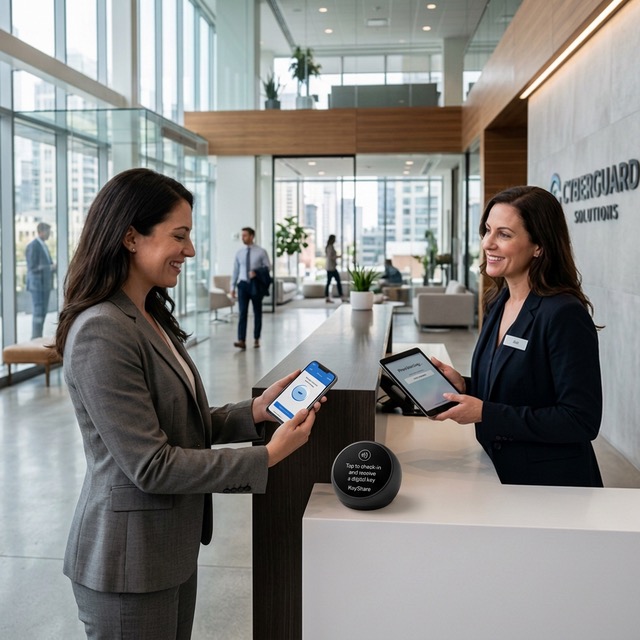
Identity-verified tap-to-provision collapses the 15-minute process into a single NFC interaction.
The visitor arrives. They tap their phone on the Puck at the reception desk. The Puck reads their digital ID (mDL or EUDI credential via ISO 18013-5), verifies the cryptographic signature, and confirms the visitor’s identity. The Visitor Experience Platform matches the verified identity against the pre-registration list, triggers a 1:1 face match (if configured — using biometric ephemerality, where face data is processed in RAM and discarded in under one second), screens against the watchlist, presents any required NDA for electronic signature, and provisions a building access credential to the visitor’s phone.
The visitor walks through the turnstile with a verified identity, a logged access event, a signed NDA, and a time-limited credential — in under 30 seconds from tap to entry.
The host receives a notification the moment the visitor is credentialed. No phone call. No waiting.
What changes operationally
Reception staffing. For buildings with Self-Service Kiosk Mode, the Puck handles the entire workflow without a receptionist. The visitor taps, verifies, signs the NDA, and receives their credential — all through a guided on-screen flow. Reception staff can focus on hospitality and exception handling rather than data entry.
Credential lifecycle. The visitor’s credential is time-limited — it expires at the scheduled departure time or at the end of the day. Overstay detection is automatic. If the visitor doesn’t badge out, the credential expires and an alert is generated. No manual badge collection at the end of the visit.
Compliance. Every visitor interaction generates a compliance record: verified identity, face match result (if configured), watchlist screening result, NDA signature, credential issuance, access events, and credential revocation. The audit trail is automatic and complete — no missing entries from visitors who “forgot to sign in.”